

Every generation experiences a technological breakthrough that changes the trajectory of civilization…
For our grandparents, it was electrification. For our parents, it was the Interstate Highway System. For many of us, it was the internet.
And today, artificial intelligence and quantum computing are emerging as the defining technologies of the next era.
The headlines are filled with stories about AI models becoming more capable by the day.
Quantum computing, meanwhile, continues to inch closer to solving problems that even today’s most powerful supercomputers can’t tackle.
Venture capital is pouring funding into startups. Technology giants are spending hundreds of billions of dollars on infrastructure.
Governments around the world are racing to secure leadership positions in what many believe will be the most important technological competition of the century.
And so, most investors naturally focus on the technology itself…
Which AI company will dominate? Which quantum computing firm will achieve the next breakthrough? Which software platform will become indispensable?
Those are important questions. But history suggests they may not be the most important questions…
Because the greatest fortunes of transformational eras are often made, not by predicting the invention, but by recognizing what the invention requires.
And what artificial intelligence and quantum computing require is an almost unimaginable quantity of physical infrastructure.
And that reality may be setting the stage for one of the largest commodity supercycles in modern history.
History Remembers the Invention and Forgets the Inputs
History tends to remember the inventions…
We remember the lightbulb, but not the miles of copper wire that carried electricity into homes and factories.
We remember the locomotive, but not the mountains of iron ore and coking coal that became rails stretching across continents.
We remember the automobile, but not the steel mills, oil fields, refineries, and pipelines that made personal transportation possible.
We remember the internet, but not the millions of miles of fiber optic cable buried beneath cities, deserts, mountains, and oceans.
We remember the websites, search engines, and social media platforms.
But we forget the data centers, power plants, semiconductor fabrication facilities, and communications networks that made the digital world possible.
You see, every great technological revolution creates a visible innovation that captures the public’s imagination.
But beneath every breakthrough lies a vast network of mines, refineries, factories, power stations, transportation systems, and industrial infrastructure.
The invention may change the world. But the raw materials make the invention possible.
And the greatest fortunes of every industrial revolution are rarely created by the invention alone…
They’re instead often created by supplying the materials needed to deploy that invention at scale.
Artificial intelligence and quantum computing may become the lightbulbs of the twenty-first century.
And they will dominate headlines, investment conferences, and venture capital presentations.
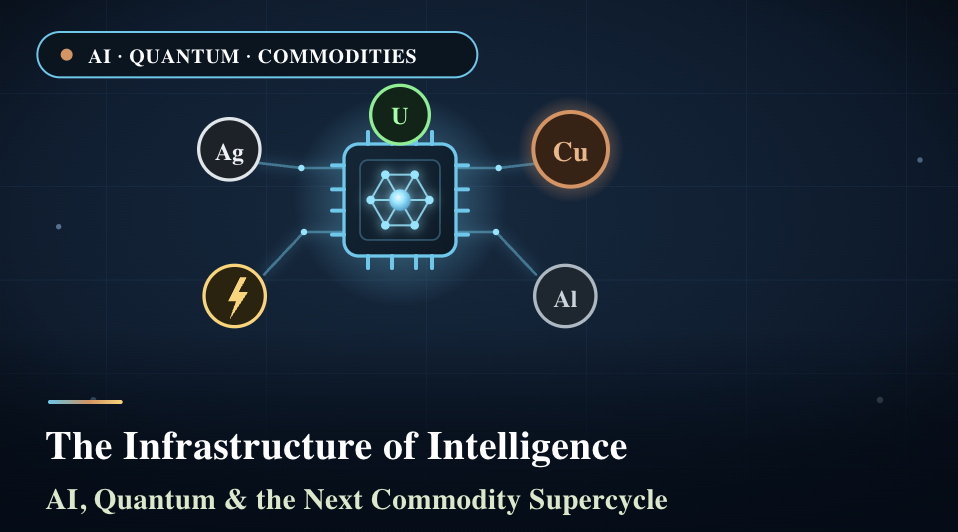
But just as Edison needed copper, railroads needed steel, automobiles needed oil, and the internet needed fiber optic cable, the AI and quantum revolutions will require enormous quantities of copper, uranium, silver, aluminum, rare earth elements, steel, cement, and energy.
And investors who focus exclusively on the technology risk missing the much larger story unfolding beneath it…
The largest physical infrastructure buildout since the internet age and perhaps since the construction of the Interstate Highway System itself.
The Interstate Highway System of the Digital Age
When President Eisenhower signed the Federal-Aid Highway Act in 1956, most Americans saw it as a transportation project. But what followed was something much bigger…
The Interstate Highway System consumed extraordinary amounts of steel, concrete, asphalt, fuel, machinery, and labor.
Entire industries grew to support its construction. Yet the highways themselves were only the beginning…
The real transformation came afterward as suburbs expanded, national retailers emerged, modern logistics networks became possible, manufacturing became more efficient, and tourism flourished.
Entire business models appeared that simply could not have existed before because the roads enabled everything that came after.
And the internet followed a remarkably similar path…
Today we think of the internet as websites, apps, cloud computing, and social media. Yet before any of those businesses could exist, someone had to lay the fiber.
Millions of miles of it.
Telecommunications companies spent decades burying cable beneath cities, stringing it across continents, and laying it along the ocean floor.
Data centers were built. Power systems were expanded. Semiconductor fabrication facilities multiplied.
And only after the infrastructure existed did the digital economy emerge.
Now, artificial intelligence and quantum computing appear poised to follow the same pattern…
The technology may capture the headlines. But the infrastructure will drive the investment opportunity.
Why AI and Quantum Need More Than Software
The popular narrative surrounding artificial intelligence focuses on algorithms.
The popular narrative surrounding quantum computing focuses on processing power.
But both narratives miss the larger story…
Every new generation of AI models requires more computing power than the one before it.
Every new data center consumes more electricity than its predecessor.
Every breakthrough in quantum computing requires increasingly sophisticated hardware, specialized materials, advanced manufacturing capabilities, and precise operating environments.
This is why technology companies are increasingly behaving like industrial companies.
They are searching for land. They are securing energy contracts. They are investing in transmission infrastructure.
They are partnering with utilities. They are even funding power projects.
And at a recent conference on artificial intelligence and quantum computing, one theme surfaced repeatedly in conversations with investors, technologists, and executives.
Not software. Not algorithms. Not chips.
Power.
Because none of these technologies function without it.
The future of computing is rapidly becoming a story about energy, infrastructure, and raw materials. And that brings us directly to commodities.
Copper: The New Oil of the Digital Economy
If there’s one commodity positioned at the epicenter of this transformation, it’s copper.
For more than a century, copper has powered electrification.
It carried electricity into homes, factories, offices, and cities. It helped build telecommunications networks and connected the modern world.
And now it finds itself at the center of another technological revolution…
Artificial intelligence may appear to be a software story, but every AI query ultimately depends on physical infrastructure.
Data centers require electricity. Transmission systems require conductive materials. Grid upgrades require transformers, substations, and transmission lines.
Copper sits at the center of all of it…
Every additional gigawatt of power generation requires copper. Every transmission corridor requires copper. Every data center requires copper. Every effort to modernize aging electrical infrastructure requires copper.
The challenge is that new supply is becoming increasingly difficult to develop.
Major discoveries are rare. Permitting timelines continue to lengthen. Existing mines are producing lower-grade ore than they once did.
At the same time, demand forecasts continue to rise.
If oil was the lifeblood of the industrial economy, copper may become the lifeblood of the digital economy.
Uranium’s Return to Relevance
Not long ago, uranium was viewed as a relic of a previous era. But today it is becoming part of the artificial intelligence conversation.
The reason is simple…
AI requires electricity. And lots of it.
In fact, the largest data centers now consume as much power as small cities. And future facilities are expected to consume even more.
Technology companies need electricity that’s available around the clock, regardless of weather conditions.
And that requirement has sparked renewed interest in nuclear energy…
Governments are embracing it. Utilities are expanding it. Investors are rediscovering it. And technology companies are increasingly supporting it.
Large reactors, small modular reactors, and advanced reactor designs are all attracting significant attention as the world searches for reliable ways to meet growing electricity demand.
But every reactor requires fuel. And for the majority of reactors, that fuel begins with uranium.
Which means that one of the oldest commodity stories in the market is suddenly becoming connected to one of the newest technological revolutions.
Silver, Rare Earths, and the Hidden Supply Chain
Copper and uranium may attract the most attention, but they’re hardly the only beneficiaries.
Silver remains one of the most conductive materials on Earth and continues to play a critical role in advanced electrical applications.
Rare earth elements have become indispensable components of modern electronics, communications systems, sensors, and defense technologies.
Aluminum is increasingly important for transmission infrastructure.
Nickel, graphite, lithium, and numerous specialty metals occupy critical positions throughout advanced manufacturing supply chains.
What makes the current environment unique is not any single commodity.
It is the convergence of multiple demand drivers occurring simultaneously.
Artificial intelligence. Quantum computing. Grid modernization. Electrification. Advanced manufacturing. National security.
Each trend independently supports commodity demand. And together, they create a powerful force that could persist for decades.
The Biggest Commodity Story in a Generation
Commodity supercycles are rare because they require something larger than ordinary economic growth…
They require a structural shift.
Railroads created one. Electrification created another. Post-war industrialization created another. China’s rise created perhaps the most recent example.
And now, artificial intelligence and quantum computing look like they’re creating the next.
The world is not simply building smarter computers.
It is building new electrical systems. New power generation. New transmission networks.
New manufacturing facilities. New supply chains. New industrial infrastructure.
And while the headlines will focus on software, algorithms, chips, and breakthrough discoveries, investors should remember the lesson that history teaches again and again.
The lightbulb required copper. The railroad required steel. The automobile required oil. The internet required fiber.
And before artificial intelligence and quantum computing can change the world, they too must be mined from the ground.
That may be the most important investment opportunity of all.