

Investors love flashy stories…
Artificial intelligence. Robotics. Hypersonic weapons. Space travel. Advanced semiconductors.
Those are the industries that dominate headlines, attract billions of dollars, and send investors scrambling to find the next big winner.
But there’s something all those industries have in common:
They must be built.
And you can’t build the future out of software alone.
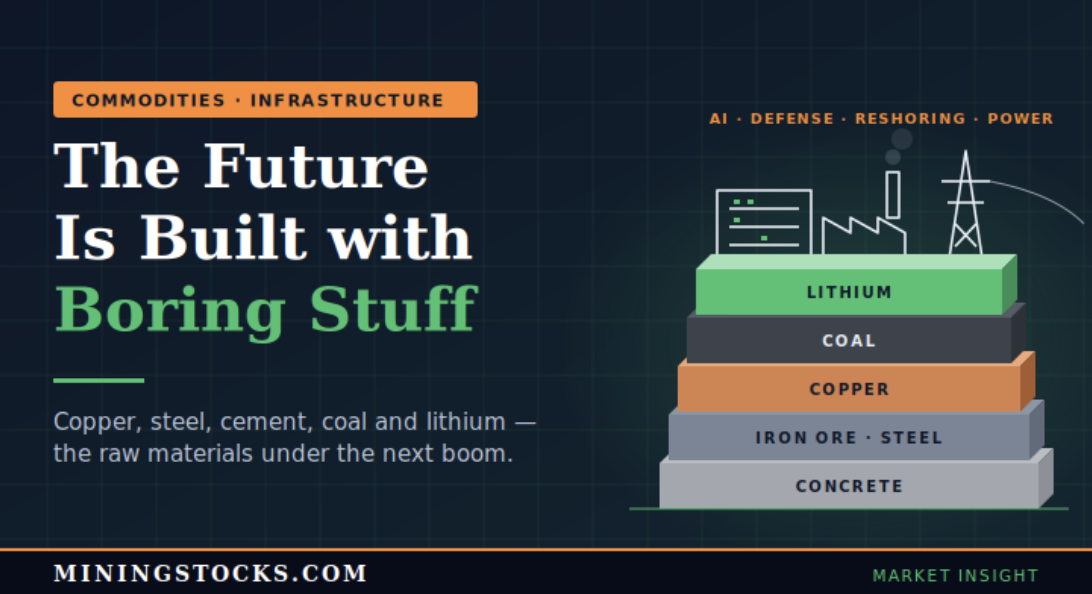
You need copper, iron ore, steel, cement, lithium, coal…
You need enormous quantities of basic materials that have been around for decades, centuries, and even thousands of years.
That’s why one of our favorite investment themes right now might also be one of the least glamorous.
The future is being built with boring stuff.
The Trade Has Changed
At the beginning of this year, the commodity trade was mostly discussed in terms of shortages.
Copper supply looked tight. Critical minerals were becoming increasingly politicized. ]Western governments were scrambling to reduce dependence on China. Tariff threats were distorting inventories.
And years of underinvestment in mining were beginning to collide with rising demand.
All of that still matters. But the story has evolved…
Today, commodities aren’t simply a scarcity trade; they’ve become an infrastructure trade.
Copper recently climbed to record highs as investors confronted a combination of supply bottlenecks, tariff concerns, and rapidly growing industrial demand.
Reuters noted that AI data-center construction and rising defense spending have become meaningful contributors to copper consumption.
And copper is essentially the circulatory system of an electrified economy.
Power lines need it. Transformers need it. Motors need it. Cooling systems need it. Electric vehicles need it. Factories need it. Data centers need enormous amounts of it.
Once you start adding up all those demands at the same time, copper stops looking boring very quickly.
AI Has Become a Construction Boom
For years, investors treated artificial intelligence as a semiconductor story…
Buy the chipmakers. Buy the software companies. Buy the cloud providers.
That made sense.
But the AI boom is increasingly turning into something much more physical.
Data centers must be built. They need giant amounts of electricity. They need backup generation. They need cooling equipment.
They need cables, pipes, transformers, switchgear, structural steel, concrete, and acres of industrial infrastructure.
Case-in-point: Reuters recently reported that America’s data-center boom is spreading deep into old-fashioned manufacturing, boosting demand for everything from generators and cooling systems to bearings, electrical cables, pipes, and cement.
And that’s the part of the AI story we think many investors are still underestimating.
You can debate whether today’s leading AI model will still dominate five years from now.
You can debate which chip architecture wins. You can even debate valuations.
But if hundreds of billions of dollars are being spent building data centers, power generation, transmission networks, and supporting infrastructure, somebody has to provide the physical materials.
And that’s a much simpler investment thesis.
You Can’t Build Infrastructure Without Steel
Then there’s iron ore, which doesn’t generate much excitement, but it does generate steel.
Virtually every major infrastructure boom ultimately requires enormous amounts of it.
Data centers, power plants, transmission towers, factories, bridges, rail systems, defense equipment, ships… all require steel.
And the same industrial spending cycle that’s boosting copper demand eventually filters into iron ore and metallurgical coal.
That’s one reason we don’t think investors should dismiss these materials simply because China’s property market — historically one of the world’s biggest commodity-demand engines — has weakened.
There are new demand centers developing.
India is industrializing. The United States is reshoring manufacturing. Europe is increasing defense spending. Power grids are being rebuilt. AI infrastructure is expanding around the world.
And governments are spending enormous amounts of money to secure domestic industrial capacity.
That demand doesn’t always show up overnight. But commodity cycles are long.
And when multiple infrastructure trends overlap, seemingly ordinary materials can suddenly become strategic assets.
Concrete Might Be the Most Boring Winner of All
If iron ore sounds boring, cement probably sounds even worse…
Nobody gets excited talking about concrete.
But almost everything we’re discussing eventually gets poured into it.
A semiconductor fabrication plant needs a foundation. The same goes for a data center, a warehouse, a power plant, a factory, even a new road needs one.
So does a bridge, a port, a military installation, and nearly every other piece of physical infrastructure governments and corporations are currently racing to construct.
The farther you move down the supply chain, the less glamorous the businesses become.
But the more unavoidable they become, too.
Investors might decide they don’t like the valuation of an AI company. But they can’t decide to build a 500-megawatt data-center campus without concrete.
Don’t Write Off Coal Either
Coal might be the most controversial example.
For years, investors were told coal demand would collapse as renewable energy expanded.
Yet global coal consumption has remained stubbornly strong.
Part of that is because electricity demand keeps rising faster than expected.
And part of it is because not all coal is used for electricity.
Metallurgical coal remains essential to conventional steelmaking.
And the world is simultaneously trying to build more factories, more defense equipment, more electrical infrastructure, more ships, and more industrial facilities.
The energy transition also isn’t happening in a straight line.
Electricity demand from AI, electrification, manufacturing, and growing economies has been so strong that governments increasingly find themselves trying to add new clean generation while keeping existing power sources online.
The world doesn’t have the luxury of shutting off dependable energy before replacement capacity exists.
That’s one reason commodity demand has repeatedly surprised investors who expected the old economy to simply disappear.
Lithium Offers a Different Lesson
Lithium shows us the other side of commodity investing.
Its prices boomed. Mining companies rushed to expand. Supply caught up. Prices collapsed. Investors fled.
And suddenly lithium became yesterday’s story.
But battery demand didn’t disappear…
Electric vehicles and grid-scale storage still need batteries.
Renewable energy systems need storage.
And governments continue spending heavily to localize battery supply chains.
That’s how commodity cycles work.
High prices generate investment. Investment generates supply. Supply pressures prices. Low prices discourage new projects.
But demand continues growing, and eventually the market tightens again.
That’s why the best time to investigate a commodity isn’t necessarily when everyone is excited about it…
It’s when nobody wants to talk about it.
The Real Infrastructure Trade
We aren’t bullish on these materials because we think every commodity will rise every day.
They won’t.
Iron ore will have bad months. Copper will correct. Lithium will overshoot in both directions. Coal will remain politically controversial.
Construction demand will fluctuate and mining stocks will be volatile.
But underneath those shorter-term cycles is something much larger…
The world is entering an extraordinary period of physical investment.
Artificial intelligence requires massive new infrastructure. Power grids require massive upgrades.
Manufacturing is being reshored. Defense budgets are growing.
Nuclear power is returning. Electricity demand is accelerating.
Critical supply chains are being rebuilt.
And governments increasingly view access to raw materials as a national-security issue rather than simply an economic one.
Every one of those trends requires stuff… Real stuff.
Stuff that has to be mined, processed, transported, poured, refined, and manufactured.
Investors need to look beyond the companies getting all the headlines.
Because some of the biggest winners of the next decade may be the businesses supplying the basic building blocks underneath everything else.
Copper miners, iron ore producers, lithium developers, cement companies, coal suppliers, industrial-material producers.
The names may not sound futuristic. Their products certainly don’t.
But that’s exactly the opportunity…
Everyone wants to build the future, but the future is built with boring stuff.