

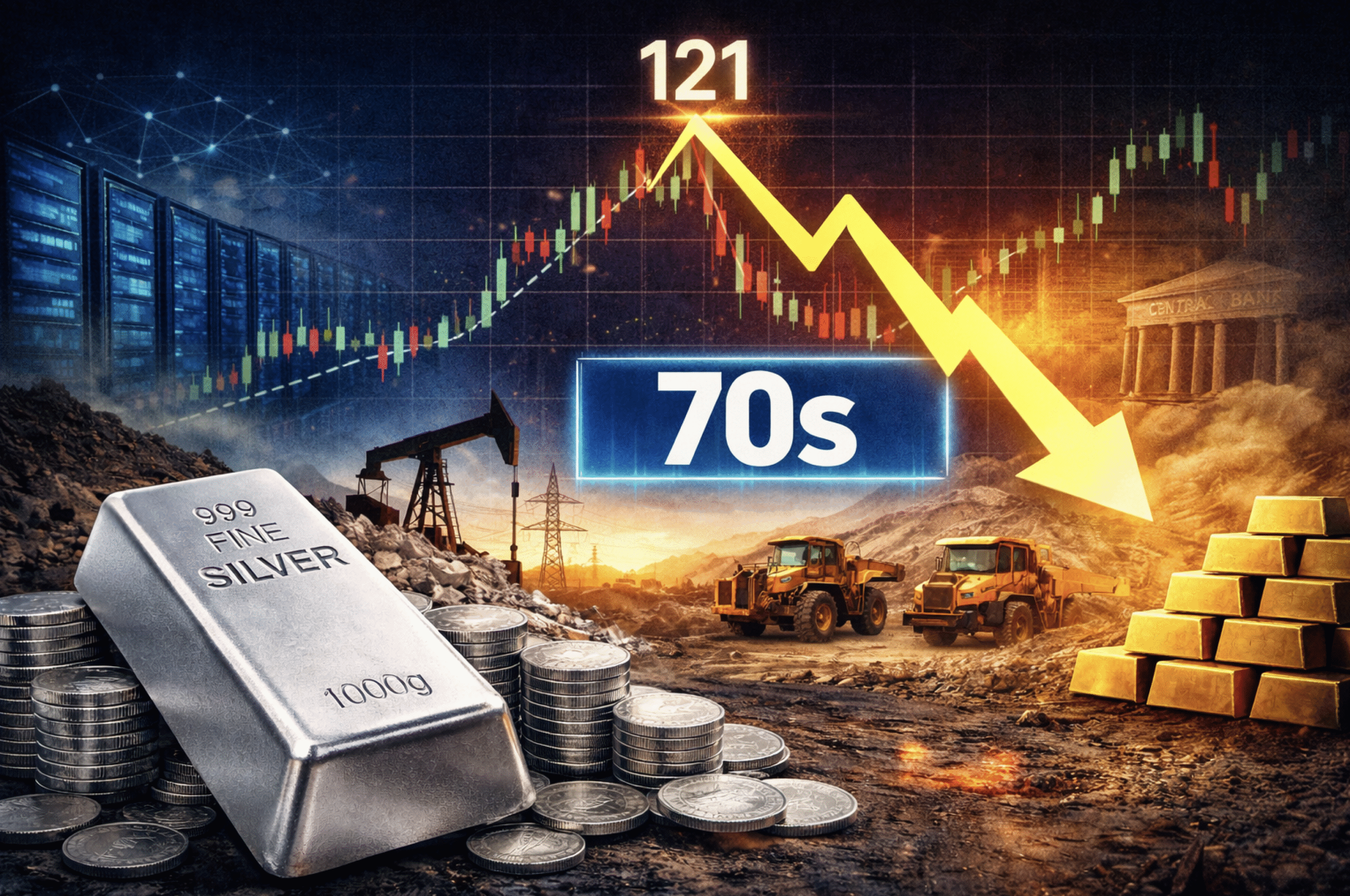
Silver didn’t just break its old $50 ceiling in late 2025 — it obliterated it. And what followed in early 2026 was the kind of vertical move that makes charts look fake and traders feel invincible.
But by the time prices tagged $121.78 per ounce, silver had traveled so far from its long-term mean that gravity was inevitable.
That’s not a knock on silver. That’s just how real bull markets behave.
When a Market Runs This Far, This Fast
Momentum traders piled in. Leverage crept higher. Exchanges tightened margin requirements. Profits were taken.
And just like that, silver slid back into the $70s — where it’s been doing something far more important than screaming higher: holding its ground.
This isn’t a breakdown. It’s digestion.
Markets don’t move in straight lines, and the most powerful trends are punctuated by moments that feel uncomfortable in real time.
If anything, the fact that silver didn’t collapse after such an extreme run is your first clue that something structural — not speculative — is going on… (click here to continue reading)
The Calendar Nobody Talks About (But Everyone Trades)
Here’s a detail most investors ignore: silver has a long history of pulling back after Valentine’s Day. Even in boring years. Even when nothing “bad” is happening.
Seasonality doesn’t drive long-term value, but it absolutely affects short-term volatility — especially in thin, leveraged markets like silver.
Add that seasonal tendency to a market that just experienced a historic surge, and you get exactly what we’re seeing now: choppy action, fast swings, shaken confidence.
Over the next few weeks, silver could easily frustrate both bulls and bears.
But that doesn’t mean the bull market is over. It means the easy money from the first momentum phase has already been made.
The next phase rewards patience — and positioning.
Why This Isn’t a Cyclical Story Anymore
In past cycles, silver demand ebbed and flowed with economic growth. That’s no longer the world we’re living in…
Electrification isn’t optional. AI infrastructure isn’t discretionary.
Data centers don’t care about recessions — they care about power, conductivity, and reliability.
And silver sits right at the center of that equation.
What makes this setup so unusual is that supply hasn’t changed to match demand…
New silver mines take years — often a decade — to permit, finance, and build.
Meanwhile, most silver isn’t even mined on purpose. It’s a byproduct of copper, lead, and zinc production, which means supply can’t simply surge because prices are higher.
That’s how you get a market where demand stops being cyclical and starts becoming structural.
Once that happens, pullbacks stop being warning signs. They become opportunities.
The Quiet Shift in Monetary Power
Silver isn’t just an industrial metal — it’s a monetary one. And the monetary world is changing faster than most investors realize.
Central banks have been telling us this story with their actions, not their words.
Gold has been replacing U.S. Treasuries on balance sheets. In many parts of the world, silver still plays a parallel role — smaller, yes, but no less symbolic.
When trust in fiat systems erodes, monetary metals don’t need hype. They just need time.
That’s why silver’s bull market didn’t end when prices fell from triple digits. It merely paused long enough to shake out the tourists.
Volatility Is the Toll You Pay for Asymmetry
Let’s be clear: the next month could be noisy…
Silver may overshoot to the downside. It may whip around just enough to convince impatient investors that “this time is different.”
It isn’t.
What is different is the backdrop…
Tight supply. Structural demand. Strategic stockpiling. A shifting monetary regime.
Those forces didn’t disappear when prices fell into the $70s. If anything, they’re stronger now — because inventories are tighter and expectations are lower.
That’s usually where the best long-term entries are found.
Why the Best Leverage Isn’t the Metal
Owning silver outright makes sense. But history shows that when a silver bull market matures, the torque moves into the producers.
Well-run miners don’t just track the price of silver — they amplify it.
Cash flows expand faster than prices. Balance sheets heal quickly. And valuations, which are often left behind in the early stages of a rally, begin to matter again.
That’s why we’re paying close attention to names like Pan American Silver, Silvercorp Metals, Apollo Silver Corp. and First Majestic Silver — companies with scale, real assets, and leverage to higher prices without needing silver to go parabolic tomorrow.
These aren’t lottery tickets. They’re businesses positioned to benefit if silver simply does what structural bull markets tend to do over time.
Staying Bold Without Being Reckless
This is not the moment to chase. It’s the moment to plan.
Silver’s seasonal volatility gives us a window — not to panic, but to build positions deliberately while sentiment cools.
That’s how long-term outperformance actually happens. Not by buying tops. Not by selling pullbacks. But by understanding where we are in the cycle and acting accordingly.
Silver already proved it can move fast. The next leg doesn’t need drama — it just needs patience.
And if history is any guide, the investors who use this pause wisely will be the ones still smiling when the crowd realizes the bull never left.