

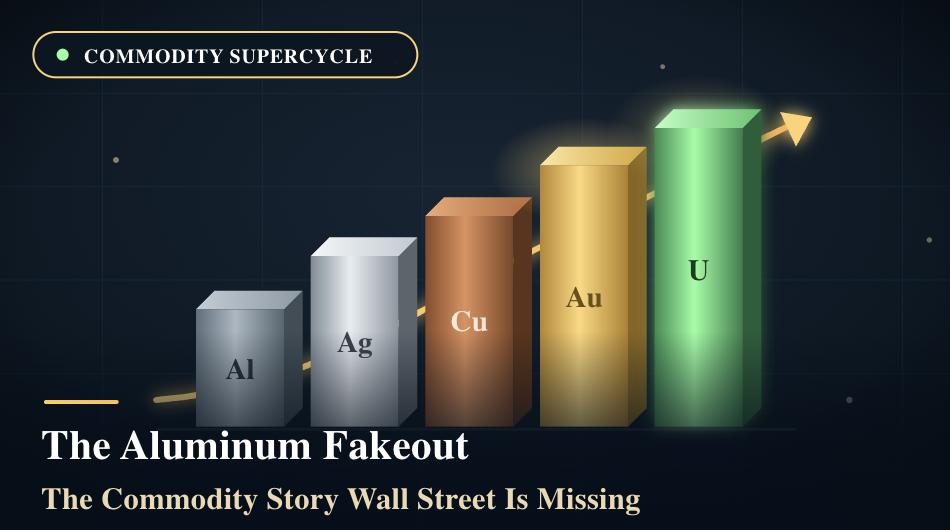
A funny thing happens at the beginning of every major investment trend…
The market starts sending signals, but almost nobody believes them.
One sector moves higher while another stands still.
One commodity breaks out while another pulls back.
A single headline changes the short-term narrative…
And commentators rush to declare the trend over before it’s really even begun.
We’ve seen it happen with technology stocks. We’ve seen it happen with gold. We’ve seen it happen with real estate.
And I suspect we’re seeing it happen again today with commodities…
You see, just a few days ago, aluminum prices climbed to their highest level in four years.
But then came news that the United States and Iran had reached a peace agreement that is expected to be formally signed later this week.
Markets immediately began adjusting for the possibility of lower geopolitical risk and fewer supply disruptions…
And aluminum retreated.
For many analysts, that will be all the evidence they need to dismiss the move as nothing more than a temporary spike driven by short-term events.
But I’m not convinced…
In fact, I think they’re looking at the wrong chart entirely.
Looking At the Forest Instead of the Trees
If aluminum were the only commodity attracting capital, perhaps the skeptics would have a point.
But that isn’t what we’re seeing…
Gold continues to push higher.
Silver began outperforming after spending years in the shadows.
Uranium remains well above the prices we saw just a year or two ago.
Rare earth elements have become strategic priorities for governments around the world.
Copper continues to benefit from enormous investment in electrical infrastructure.
Each commodity has its own story and each responds to its own supply and demand dynamics.
Each will have its own corrections and consolidations, too. Yet together they tell a much larger story…
And that story is one of investors rediscovering the value of tangible assets after spending more than a decade chasing businesses that required very little physical capital.
The Physical Economy Is Back in Focus
For years, Wall Street rewarded companies that could grow without building factories, opening mines, or laying transmission lines.
Software became more valuable than steel. Cloud computing became more exciting than copper.
And capital flowed toward businesses that could scale with code instead of concrete.
There was nothing inherently wrong with that. Many of those companies created enormous wealth.
But the enthusiasm for asset-light businesses came with an unintended consequence…
The industries responsible for producing the materials that make modern life possible received comparatively little investment.
New mines became harder to finance. Refineries were delayed. Smelters closed. Exploration budgets shrank.
Then the world decided it wanted more of everything…
More data centers. More electricity. More transmission lines.
More domestic manufacturing. More defense production.
More advanced reactors. More electric vehicles. More infrastructure.
And every one of those ambitions depends on physical materials.
The Other Side of the AI Story
Artificial intelligence has become the defining investment theme of this decade.
And most investors naturally focus on the software companies, semiconductor designers, and hyperscale cloud providers leading that revolution.
But every digital revolution has a physical foundation…
A data center isn’t just a collection of chips. It’s aluminum framing, copper wiring, steel beams, concrete foundations, cooling systems, transformers, and massive amounts of electricity.
The same is true for defense modernization…
The same is true for electrification…
The same is true for rebuilding domestic manufacturing capacity…
But these trends aren’t competing for capital. They’re reinforcing one another.
The result is a steady repricing of the companies and commodities that make those ambitions possible.
Supercycles Rarely Announce Themselves
One of the biggest misconceptions investors have about commodity supercycles is thinking that everything rises together while history suggests otherwise…
Leadership rotates.
Precious metals may lead for a period before industrial metals take over.
Energy may pause while critical minerals advance.
Copper may consolidate while uranium rallies.
Short-term volatility is part of the process, but the broader trend is what matters.
That’s why aluminum’s recent pullback doesn’t strike me as a warning sign.
If anything, it reinforces the idea that markets are separating temporary geopolitical influences from longer-term structural demand.
The headlines change from week to week…
But the underlying need for more energy, more infrastructure, and more industrial capacity does not.
A Trend We’ve Been Preparing For
Readers know this isn’t a new idea for us.
For years we’ve discussed the possibility that hard assets would eventually regain leadership after a long period of underperformance.
We’ve written about uranium before nuclear power returned to favor.
We’ve highlighted critical minerals before they became mainstream policy priorities.
We’ve argued that AI would create opportunities far beyond software, extending into energy infrastructure, mining, processing, and industrial manufacturing.
Every new development strengthens that thesis.
Not because every commodity moves higher every day, but because more pieces of the puzzle continue to fall into place.